DESCRIPTION
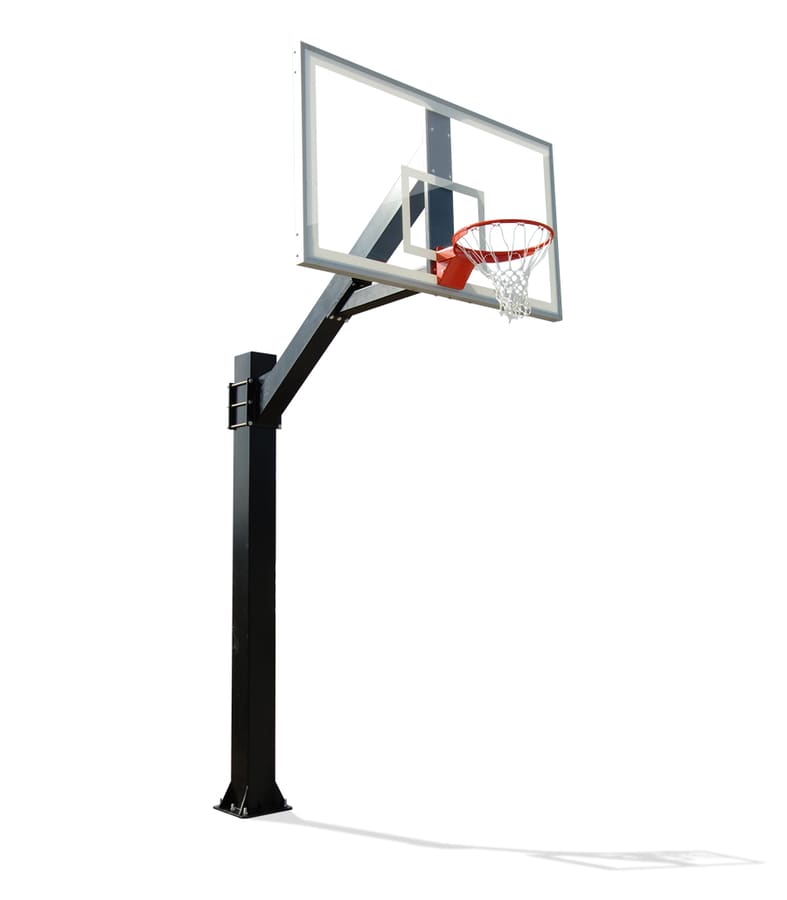
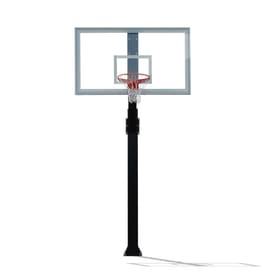
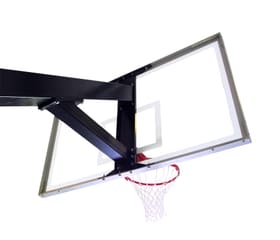
33% more glass. 9% better rebound than the closest alternative.
Almost every gymnasium board is ½-inch tempered glass; most residential hoops use thinner or softer materials. So we tested it: identical boards, identical framing, a ball dropped from 55 inches, a high-speed camera to measure the bounce.
Tempered glass is about four times heavier than acrylic — that mass firms up the whole system — and it's harder, which kills the drumhead effect that deadens rebounds on acrylic boards. Like a windshield, it resists scratching and stays clear where acrylic scuffs and clouds.
Acrylic does have its place: we recommend it for institutional courts where vandalism is likely. For a driveway, glass wins.
BACKBOARD MATERIALREBOUND RESPONSE
½" tempered glass (ours)winner · +9% vs ⅝"
⅝" tempered glass−9%
Acrylic38%
DESCRIPTION
Mounted the way NBA and NCAA boards are — mechanically, never glued.
The glass sits in a ¼"-thick die-cast aluminum frame, locked at each corner with ¼" steel L-brackets, in a channel lined with a rubber gasket. No pressure on the glass, no adhesive.
Many residential systems glue the glass to the frame. Adhesive weakens in the elements and exposes the glass edges — the place breaks start. The mechanical method costs more and lasts longer.
Support lands where bank shots actually hit: square joints are more rigid than curved, and the structure is placed at the crucial zone instead of sacrificed to styling.
DESCRIPTION
The quickest way to judge any hoop: check the pole.
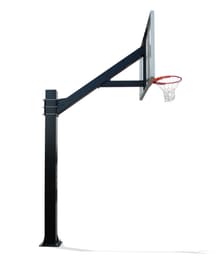
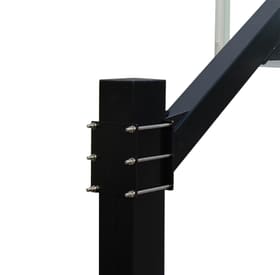
Every HERCULES rides a one-piece, square, 7-gauge (3/16") steel pole. As steel prices rise, many manufacturers quietly thin their poles — less stiffness, more wobble.
Stay away from multi-piece poles. They're split for cheap shipping, and the joints are the weak link right out of the box; corrosion only widens them. Every premium hoop ever made uses a one-piece square or rectangular pole. There's a reason.
DESCRIPTION
Galvanized in molten zinc at 860°. Still handsome in twenty years.
With the Rust Armor package, the main structural parts pass through a bath of molten zinc — hot-dip galvanization — forming an impermeable zinc-carbonate layer that also acts as a sacrificial anode: the coating corrodes so the steel can't. Every fastener upgrades to stainless steel (UNS S20100): no rust streaks, no seized bolts — which also makes the system easy to unbolt and move to your next house.
The system is designed to stay that way to look at, too: a proportionate, thin-bezel board, minimal clutter behind the glass, a pole no taller than it needs to be. Branding is a small sticker on the backboard and arm — we don't treat your system like a billboard. Tempered glass stays clear for decades where acrylic goes dull; Rust Armor keeps the steel from ever becoming the eyesore on the street.
DESCRIPTION
Warranted for dunking and hanging. Padded for everything else.
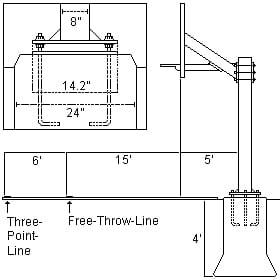
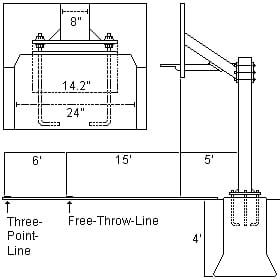
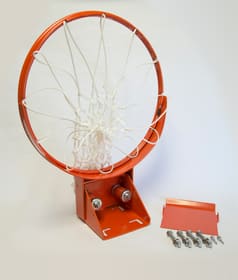
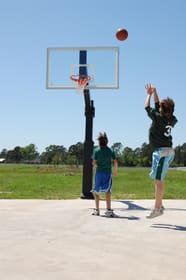
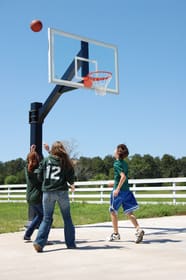
Every system includes wrap-around pole padding for players driving hard to the rim and gusset padding so nobody rolls an ankle on the base; backboard padding is available for heads at dunk height. The heavy-duty breakaway rim absorbs dunks and pops back. Overhang is a safety feature too: with the backboard 4 to 5 feet in front of the pole, the pole leaves the playing area and lay-ups have room to land.
Forty years of building hoops went into a system designed for aggressive play — and warranted for it, for a lifetime, dunking and hanging included. Most manufacturers didn't design for that, so they won't cover it. With Rust Armor, corrosion damage is covered for a lifetime too, coastal salt included.
DESCRIPTION
Assembled standing on the ground. About 15 fasteners. No ladders.
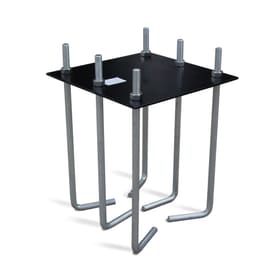
Plan on roughly 1.5 hours to set the pier, 1 to 5 days of concrete cure, then about 1.5 hours of assembly — all from a standing position, no ladders or special tools. Backboard padding and the H-bracket arrive pre-installed, which top assembly pros say saves about 30 minutes.
Self-leveling nuts square the system after the pier cures, and the rim height is calibrated at the end so it's exact. Phone support from an experienced installation expert is included — a real person.